

Read the full article by Pat Elder (Military Poisons)
“The Maryland Department of the Environment (MDE) has issued a new fish consumption advisory for certain locations based on levels of PFAS for 15 fish species found in Maryland waterways.
The state is allowing the consumption of dangerous levels of the carcinogens in seafood. The MDE is refusing to investigate fish contamination at ‘point sources,’ which are expected to be the cause of contamination in the rivers and the bay. They are only setting advisories on PFOS, when there are many potentially dangerous PFAS compounds that may accumulate in fish. They claim the contaminated Blue Crabs and Oysters have no need for limits.
During a Dec. 7 webinar John Backus of MDE explained ‘The agency stands by the data they’ve chosen and the science that is supported by EPA.’
Known concentrations of PFOS in Maryland’s fish exceed EPA standards many thousands of times over!
The Oysters
Before examining the current advisory, we must recall the MDE’s chicanery in 2020 when they used unusually high detection limits for PFAS compounds. For instance, see the MDE’s St. Mary’s River Pilot Study of PFAS Occurrence of Surface Water and Oysters, September 2020. This is important to consider because the state did not release data on oysters to substantiate its recent claim that the bivalves throughout Maryland are OK to eat.
The tests performed by Alpha Analytical Laboratory for MDE had a detection limit for oysters at one microgram per kilogram (1 µg/kg) which is equivalent to 1 part per billion, or 1,000 parts per trillion. (ppt.) Consequently, as each PFAS compound was detected individually, the analytical method employed was unable to detect any one PFAS present at an amount of less than 1,000 parts per trillion.
Because the detection limits of the tests performed by Alpha Analytical were so high, the results for each individual PFAS in the Oyster samples were ‘Non-Detect’ (ND). At least 14 PFAS were tested in each sample of oyster tissue, and the result for each was reported as ND. Some samples were tested for 36 different PFAS, all of which reported ND. However, ND does not mean that there is no PFAS!
Leila Marcovici is a scientist, attorney, and chemical patent specialist in New York. She explained, ‘The analytical methods and basis for the screening criteria used by MDE are questionable, resulting in a misleading of the public, and providing a deceptive and false sense of safety. The MDE’s conclusion over-reaches the reasonable findings based on the actual data collected and falls short of acceptable scientific and industry standards on several fronts.‘
Tim Whitehouse with Public Employees for Environmental Responsibility, PEER found 6,650 ppt of total PFAS in backfin Crab meat and 2,070 ppt in Oysters in St. Inigoes Creek, very close to the site of MDE’s testing. The site is about 2,000 feet across the creek from the Webster Field Annex of the Patuxent River Naval Air Station where aqueous film-forming foams were used in routine training exercises for many years. See the results provided by Eurofins.
Whitehouse also tested a Rockfish caught in the St. Mary’s River that contained total PFAS of 23,100 ppt, including 15,000 ppt of PFOS.
The Crabs
‘Crabs and oysters have tested below levels of concern,’ John Backus of MDE explained during a Dec. 7 webinar.
Maryland Fish Consumption Advisories

MDE says the public may enjoy blue crab from Baltimore city’s waters, although the agency says people should avoid eating the crab mustard.
In 2021 the MDE warned the public to refrain from eating the hepatopancreas, also referred to as the mustard, or ‘tomalley’ in crabs. Today, the ban on eating the delicious crab mustard only applies to crabs caught in the highly industrial areas of Baltimore city. Now its OK to eat the highly contaminated substance ‘sparingly’ everywhere else.
Although the MDE isn’t interested in tracking PFOA in crabs or other seafood, the carcinogen is known to accumulate in certain fish species as well as crabs and clams. A South Korean study shows concentrations of PFOA at 16,900 ppt. The levels of PFOA and PFOS were significantly higher in the eggs and hepatopancreas than in the legs and body of the crab. Maryland should be studying this. Clams have been shown to contain 20,000 ppt of PFOA , a concentration that is 5 million times over what the EPA says is potentially dangerous in drinking water.
Other PFAS compounds like: PFDoDA, PFTeDA, PFPeA, PFTrDA, PFUnDA, PFOSA, PFBA, PFNA, PFDA, PFDoA, PFPeS, and 6:2 FTS are known to be present in seafood, sometimes in the hundreds of thousands of parts per trillion. The levels of these toxins may dwarf the PFOS in fish, but MDE isn’t concerned about them.
PFDoDA is dangerous because it is associated with liver disease, cardiac defects, gestational diabetes, and eczema. PFUnDA accelerates the development of diabetes. PFNA and PFDA are closely regulated in drinking water in many states, although not Maryland. They are all believed to be dangerous.
What’s in your seafood, Maryland, and how is it making you sick?
The water
The MDE just published data on surface water. See Part 2 of this series. In 2020 the MDE reported finding two PFAS compounds in St. Inigoes Creek, not far from the burn pit of the Webster Field Annex of the Patuxent River Naval Air Station. They reported 4.33 parts per trillion of total PFAS (PFOA – 2.10 and PFHxS – 2.23). The MDE concluded, ‘surface water recreational exposure risk estimates were significantly below MDE site-specific surface water recreational use screening criteria.’ They provided no description of what this screening criteria entails.
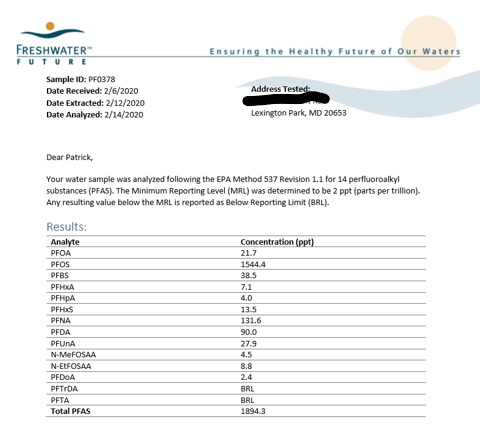
We reported finding 23 PFAS compounds with 6,449.2 ppt of total PFAS, together with a staggering 3,660.9 ppt of PFOS in the foam on the beach, about 2,000 feet from the MDE test site. We have also found 1,894.3 ppt in the water, including 1,544.4 ppt of PFOS shortly after the foam dissipated. It’s noteworthy that MDE’s testing in St. Inigoes Creek showed no results for PFOS.
Sure, we are testing near the shore where the wind, current, tide and waves conspire to create the perfect foam storm.
23 chemicals exist in the creek while the MDE would have us believe otherwise. We must study the fate and transport of PFAS in water.
Maryland’s New Fish Consumption Advisory
Many areas in the state are already covered by fish advisories because of potentially dangerous levels of Mercury, PCBs, and pesticides. For instance, Maryland set a fish advisory limiting consumption of Smallmouth Bass to 3 fish per month for women, based on the levels of mercury found in the fish in the Potomac River.
See the section of the advisory below for fish caught north of Washington, D.C., between Dam 3 and Dam 4 on the Potomac. Antietam Creek flows into the Potomac in this stretch of the river.
Maryland says it’s OK for women who are pregnant or may become pregnant to consume 3 Smallmouth Bass monthly from the river. In 2018 scientists with the U.S. Geological Survey reported finding PFOS in the blood plasma of Smallmouth Bass taken from Antietam Creek where it flows into the Potomac River. The average PFOS level among all 34 plasma samples was 381,000 ppt. The highest PFOS level was 574,000 parts per trillion.
PFOS levels in fish tend to be highest in the blood and livers of fish, with lower levels in their fillets. People often bake, fry, and consume the entire fish, which includes the blood.
In Maryland a pregnant woman may consume 3 servings a month of Smallmouth Bass averaging 381,000 ppt of PFOS.
There is a strong association between PFOS and the overall risk of infectious diseases in early childhood. There is also a strong indication of immunosuppression, with diminished childhood antibody response to vaccination, particularly with PFOS and PFOA exposures. This is why scientists are so concerned about the pregnant women. The chemicals may also cause dangerously high blood pressure levels in pregnant women.
Some frightening math
The EPA says the ‘chronic reference dose’ for a pregnant woman weighing 50 kilos is .00001185 mg of PFOS allowed per month from all sources. Maryland allows .259461 mg of PFOS consumed in fish monthly for our 50-Kilo pregnant woman. Maryland’s advisory is 21,895 times over the EPA’s chronic reference dose. (See calculations at end.)
The math examines the ‘allowable’ reference dose for PFOS. It assumes that the pregnant woman is eating PFOS in fish with no other exposures!
I asked Philippe Grandjean, MD, PhD, adjunct professor of environmental health at Harvard T.H. Chan of Public Health and professor of environmental medicine at the University of Southern Denmark, to look at the math before I presented it here. He said it was correct, assuming that the woman does not get any PFOS from any other source.
I asked Sonya Lunder, the Sierra Club’s Senior Toxics Advisor for the Clean Water, Toxic Chemicals, and Climate Resilience Program about this and she agreed with Dr. Grandjean.
Fish are such a major source of exposure that the ‘relative source contribution’ of drinking water or other sources is minimal. We ought to know the relative source contribution (RSC) the MDE used to develop its fish advisories. Some European studies suggest up to 86% of the PFAS in our bodies comes the fish. Perhaps the MDE will somehow argue that just a tiny amount of overall PFOS consumption comes from the fish?
Their position is untenable. It is indefensible. They ought to follow the science.
The same topic came up during the MDE’s online session on December 7, after a colleague asked about the levels of PFOS in fish compared to the low maximum contaminant levels (MCL’s), being mulled by the EPA in drinking water. John Backus replied, ‘It’s important to note that the MCL is for drinking water, and it is totally not related but it’s still important in informing the state what our PFAS burden is. So, that criteria obviously could change. You know, there’s been some proposals by EPA that have a different drinking water number. It’s different. It is as simple as that.’
I asked Linda Birnbaum, the former Director of the National Institute of Environmental Health Sciences (NIEHS) and the National Toxicology Program (NTP) if this sounded right. She didn’t think so. ‘Oral is oral,’ she explained. ‘Both are routes of ingestion. Whether you eat it or drink it, PFAS go to the same places in the body and do the same thing. We need appropriate fish advisories and regulations,’ she said.” …